

El Salvador’s New Airport Terminal: Everything You Need to Know
The new arrivals terminal officially opened on June 23rd — a $50 million expansion completed in eight months, financed through CEPA’s own operating revenues with no external debt. For a project of this scale, that’s a relatively clean way to get it done.
The first flight to officially land and be processed through the new terminal was an American Airlines route from Miami, carrying 172 passengers.
What’s Actually New
The expansion isn’t cosmetic. The numbers tell the story clearly:
- Check-in capacity jumped from 82 to 122 service points, 40 new counters added overnight.
- Baggage handling went from 6,000 to 16,500 bags per hour, thanks to eight new conveyor belts (twelve total.)
- The terminal now serves around 6,000 passengers daily, with infrastructure designed to scale well beyond that.
- The goal is to get arriving passengers out of the terminal in under 30 minutes.
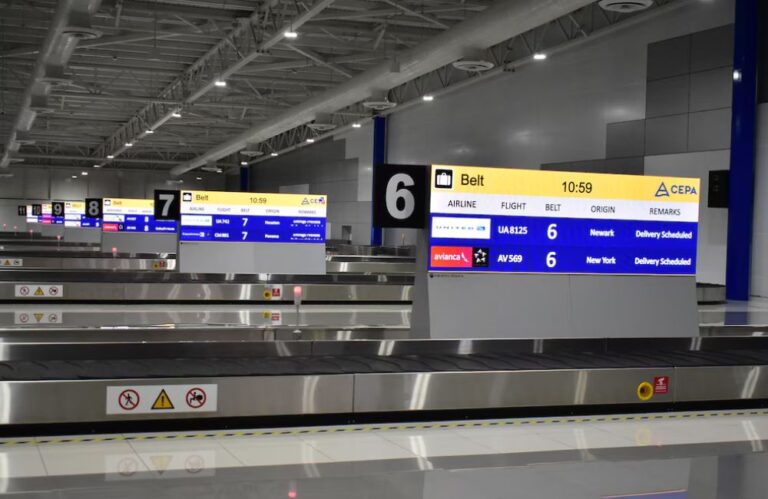
Image by Verónica Martínez, La Noticia SV
The building itself is spread across three levels and includes a redesigned immigration zone, modern queue management systems, and a layout built around passenger flow. The architectural design takes a nod toward El Salvador’s surf identity: the upper structure is meant to evoke the shape of a surfboard, and wave-inspired elements run throughout the welcome area. It’s subtle enough to not feel gimmicky, and it works.
On the security side, CEPA (Comisión Ejecutiva Portuaria Autónoma) introduced Orion dual-view scanners that can inspect baggage in seconds, plus a robotic customs assistant used by the Dirección General de Aduanas that can confirm or rule out suspicions about substances in minutes. The terminal is also fully family-friendly and pet-friendly, with dedicated service lines for children, elderly passengers, and people with reduced mobility.

Image by Verónica Martínez, La Noticia SV
Why This Matters Beyond the Stats
Here’s the honest take: El Salvador passed 5.2 million passengers in 2025 and is projecting over 4.2 million tourists in 2026 alone. The old capacity was already straining under that volume. During Semana Santa (a special holiday vacation between March and April) this year, the airport moved more than 172,000 passengers in a single week, and over 15,600 per day. That’s not a travel surge. That’s a new baseline.
The expansion is part of a broader $320+ million airport investment portfolio, with six new boarding gates and a parking structure in the pipeline. There’s also a $195 million IDB modernization loan approved in November 2025 to continue the work. And separately, AEROMAN’s new Hangar 7, inaugurated in April 2026 and reportedly the largest aeronautical maintenance center in the world, adds another layer to what San Luis Talpa is becoming as an aviation hub.
What you’re seeing isn’t a single project. It’s a build-out in stages, timed to match the growth in demand.
What It Means If You’re Coming (or Already Here)
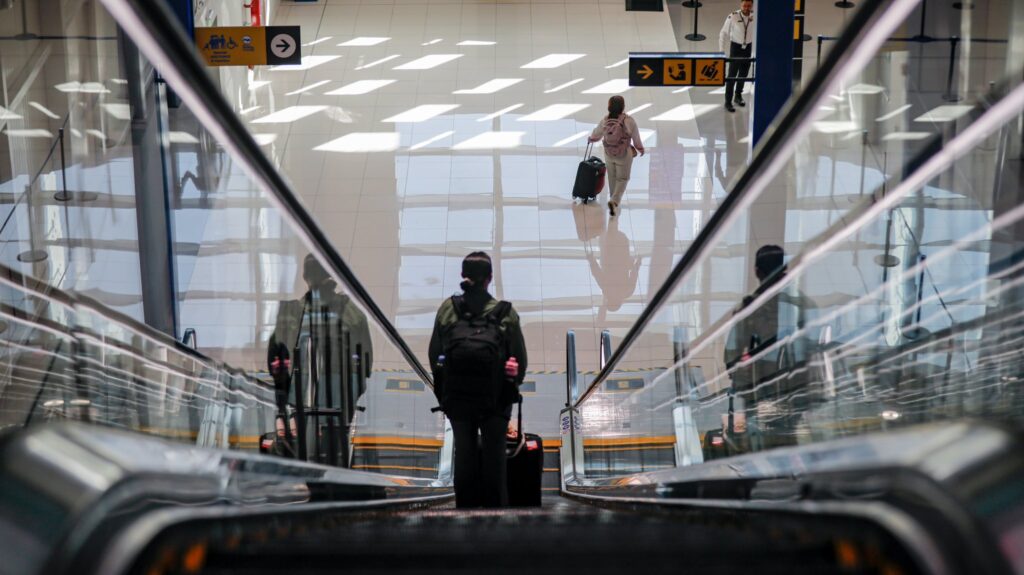
Image by Verónica Martínez, La Noticia SV
If you’ve been holding off on visiting El Salvador because the airport experience felt like a bottleneck, that concern is largely addressed now. The arrivals process is faster: the check-in lines are shorter, and the tech infrastructure backing it is legitimately modern by international standards.
If you’re already living here or own property here, this matters for a simple reason: international connectivity drives real estate value. More direct routes, more airlines, easier arrivals, that all translates into more buyers, more renters, and more demand in coastal and urban markets.
Airlines are already adding frequencies. New destinations in North and South America came online in early 2026, and competition among carriers operating out of SAL is increasing. That means more options and eventually better prices for the routes that matter.

Image by Verónica Martínez, La Noticia SV
It would be easy to look at this as just an infrastructure story, but the airport is probably the most direct physical signal of where El Salvador is heading. When a country’s first entry point looks and functions like a serious international hub, it changes how people (investors, tourists, expats) think about the rest of what’s here.
This year, our country received Level 1 travel status from the U.S. State Department. It hit 3.9 million visitors in 2024, up 17% in a year. The new terminal just absorbed the pressure that growth created and built capacity for the next wave.
El Salvador’s story is still being written, it has always had the coastline, the waves, and the people. Now it’s getting the infrastructure to match.
The airport is just one chapter. But first impressions matter, and this country is starting to make a very different one.
If you have been interested in El Salvador, this is the right time to stop looking and start coming.
Featured image by aviacionline
